
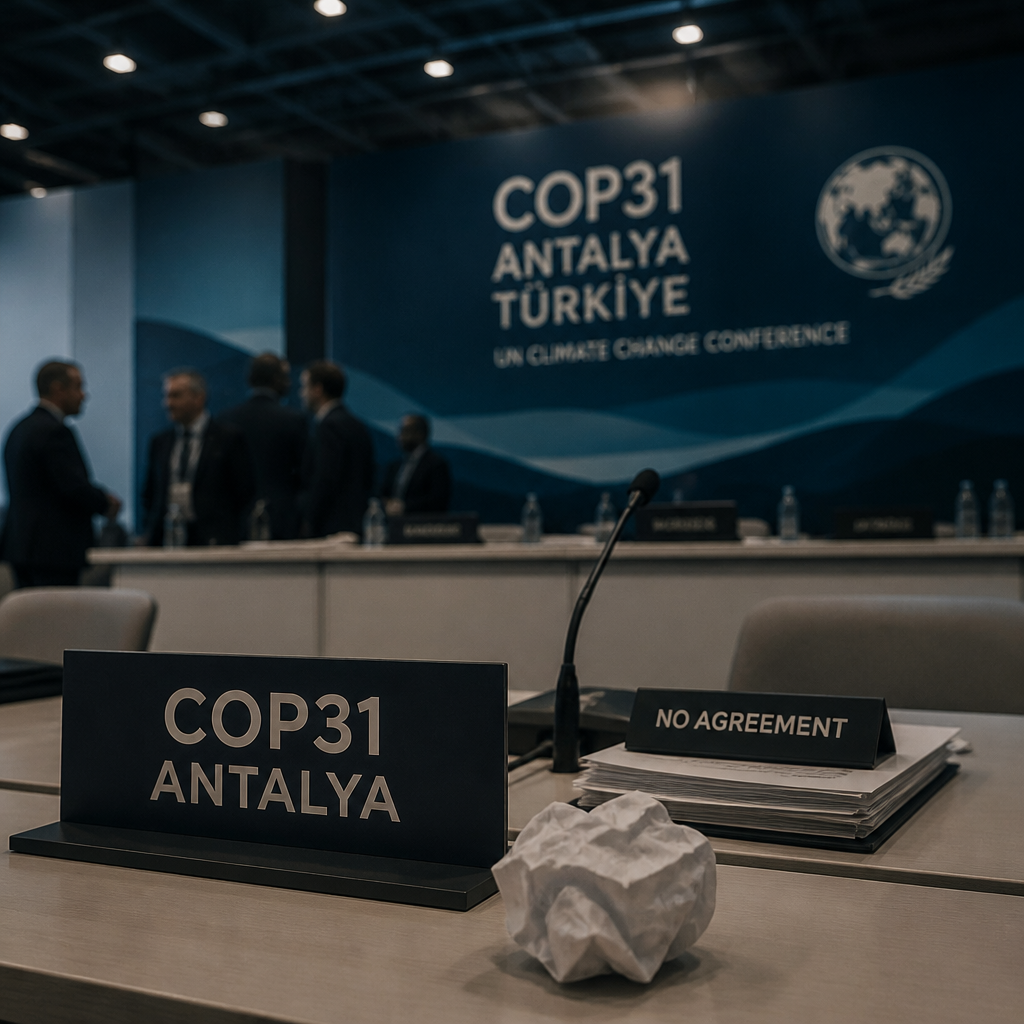
I think they were right. A text that cannot name the main cause of the problem is not a compromise worth having. Saying no took some courage, and it deserves credit.
But I do not want to spend this article on who was to blame. The more useful question is a longer one. After more than thirty years of these summits, can this approach deliver change on the scale we need? And if it cannot, what will?
Three Decades of COP Negotiations: An Honest Record
The first COP met in Berlin in 1995. The process has real achievements. It gave us the Paris Agreement, and in Dubai in 2023 countries agreed for the first time to transition away from fossil fuels.
Its defenders have a case. Closing COP28 in Dubai, UN climate chief Simon Stiell said that without these conferences the world would be headed for close to 5°C of warming, against just under 3°C now.
Two points of context matter. This is the UN climate secretariat's own estimate of what might have happened, not a measured result. And Mr Stiell was not claiming success: in the same breath he said that just under 3°C still means mass human suffering. I take it as he meant it. The curve has bent, but nowhere near far enough.
Now look at the other side of the ledger. Greenhouse gas emissions have risen by 34 per cent since 1995. Total carbon dioxide emissions are projected to reach a record 43.3 billion tonnes in 2026.
The damage also goes well beyond carbon. Scientists track nine planetary boundaries that keep the Earth stable, covering climate, fresh water, land, oceans and the living world. Seven of the nine have now been breached. A COP argues over the wording on one of them.
So the process has slowed the damage. It has not reversed it. After thirty-one summits, that is a pattern, and one more meeting is unlikely to break it.
Why Agreement Is So Hard: The Economics Point the Wrong Way
I do not believe negotiators fail for lack of effort or goodwill. They fail because we ask them to agree on shared sacrifice while the economy rewards the opposite.
Today a forest is worth more on the balance sheet once it has been felled. Healthy soil, clean rivers and a stable water cycle appear in no national accounts. Destroying them looks like income. Repairing them looks like cost.
While that remains true, every climate pledge works against the grain of the economy. Political commitments matter, but they cannot carry the whole load.
You can see what that accounting gap looks like on the ground. Explore the live extreme weather data on the BRP Earth Monitor.
Whole Earth System Accounting: Putting the Living Earth on the Books
Our central proposition at Envisionation is simple. Change the underlying economics, and restoration follows.
The tool for this is Whole Earth System Accounting. In plain terms, it means recording the health of the planet's living systems in our economic accounts, as the productive capital they are. A well-run company maintains its core assets and counts their decline as a loss. We should do the same for forests, soils, oceans and the water cycle.
Once those assets are on the books, two things change. The true cost of destroying them becomes visible in finance and policy. And restoring them shows up as what it is: an investment that raises productivity.
This thinking underpins Empathy Economics, our economic framework. The name is not about sentiment. It starts from the fact that the economy is a wholly owned subsidiary of the living Earth, and it aligns incentives accordingly.
It is also the engine of the Biosphere Restoration Plan, our for-profit programme to restore ecosystems on land and sea. The plan does not ask anyone to wait for 200 governments to agree. It asks whether restoration can pay. We believe it can.
Restoration Is an Enormous Economic Opportunity
This is where I find real cause for optimism.
The World Economic Forum estimates that nature-positive business transitions could generate up to USD 10.1 trillion in annual business value and 395 million jobs by 2030. That is an independent figure, and it describes a growth story.
Our own analysis points the same way. Today about 2.8 billion people live well. With a functioning biosphere and the right economic framework, we believe 9 billion could do so by 2050. Meeting that demand through restored land, water and oceans would be the largest expansion of productive capacity in history.
None of this replaces diplomacy. Emissions still have to fall, and future COPs still matter. But when restoration earns a return, governments no longer have to be persuaded to accept a cost. They are being invited to share in a gain. That is a far easier agreement to reach.
FAQ
Why did COP31 end without a deal?
The final draft of the Antalya Pact omitted fossil fuels. The EU and several climate-vulnerable and other nations judged it inadequate and formally objected, so no pact was adopted.
What is Whole Earth System Accounting?
It is a way of recording the value and health of the Earth's living systems in economic accounts, so that damage registers as a loss and restoration registers as an investment.
What is Empathy Economics?
Empathy Economics is Envisionation's economic framework. It treats the atmosphere, oceans, soils, forests and biodiversity as core assets and aligns financial incentives with their health.
Conclusion
Antalya was a disappointment, but it was also clarifying. The countries that refused a hollow text showed that ambition is alive. What they lack is an economic system that rewards it.
That is something we can build. Value the living Earth properly and restoration stops being a burden to be negotiated. It becomes an opportunity to be seized, by investors, businesses, farmers and governments alike. I believe that is the practical way forward, and I believe it is within reach.
If you would like to explore the framework in more depth, start with Empathy Economics and the Biosphere Restoration Plan.


