
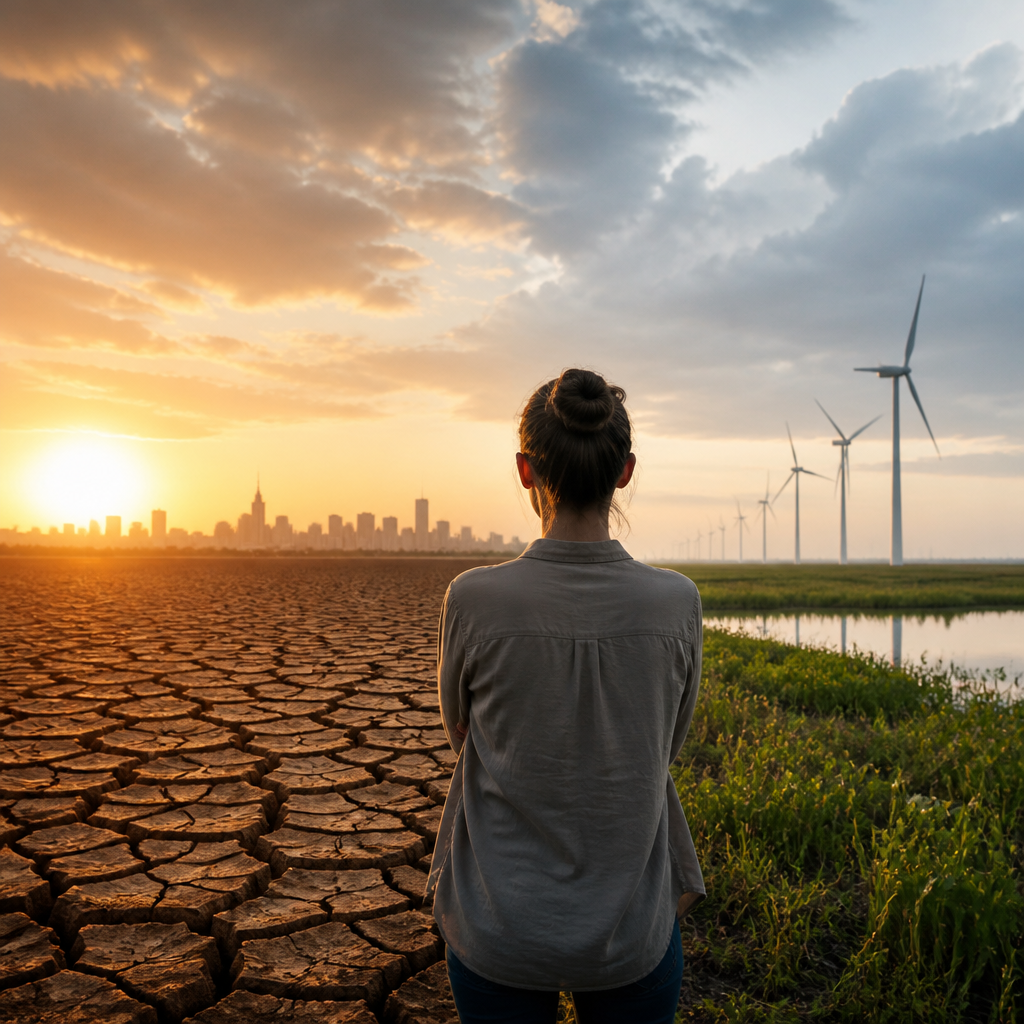
The strongest El Niño in at least 1,000 years is bearing down on the UN climate talks in Antalya, according to the Guardian. It has already fed wildfires and crop failures in Indonesia, severe drought in Sudan and flooding in Ecuador and Somalia. Behind each of those headlines are families who have lost homes, harvests and people they love, and that has to be said first.
At Envisionation we study how the whole Earth system absorbs shocks like this one. I do not see the meeting of El Niño and COP31 as bad luck or bad timing. I see it as a stress test.
If the agreements signed in Turkey cannot withstand a natural cycle we have known about for generations, they will not withstand what is coming. So, if you report on these talks, allocate capital around them or comment on what they produce, here is a sharper frame than disaster-by-disaster coverage, and five questions to put to whatever Antalya delivers.
The Gap Between the Headlines and the Negotiating Text
Celeste Saulo, Secretary-General of the World Meteorological Organization, has called this El Niño a “risk multiplier”. The WMO State of the Climate Update for COP31 expects it to reach record strength by December and to raise the risk of extreme heat, drought and heavy rainfall well into 2027.
The money tells the same story. On the opening day of the summit, IFAD warned that this El Niño could cost the global economy up to US$11 trillion. UNEP’s Adaptation Gap Report 2026 puts developing countries’ adaptation needs at around US$305 billion a year by 2035, against international public flows of roughly US$28 billion in 2024.
That is the gap the people I speak to keep describing. Editors have more extreme weather copy than they can run and too few credible answers to publish beside it. Fund managers have capital earmarked for climate and too few scalable, investable projects to put it into.
Everyone can describe the problem. Almost nobody is tabling a plan sized to it.
Watch the stress test unfold as the talks proceed. Explore the live extreme weather picture at BiosphereRP.com/dashboard/extreme-weather.
Why El Niño at COP31 Demands a Systems-Level Answer
My argument is simple: read this El Niño as a diagnostic as well as a disaster. El Niño is a natural oscillation in Pacific Ocean temperatures. It does not create new heat. It releases heat the ocean already holds, and the WMO reports that ocean heat content is heading for its tenth consecutive record year.
A healthy biosphere, with intact forests, living soils and functioning water cycles, absorbs much of that shock. A degraded one amplifies it. Drought triggers fire, fire strips soil, and stripped soil turns the next rainfall into flood.
That is why Envisionation’s Biosphere Restoration Plan starts from the system, not the symptom. It is a framework for restoring the planet’s capacity to buffer shocks. It is also designed to be profitable, decoupling growth from degradation rather than asking nations to pay indefinitely for damage control.
COP31 does not need another emissions target layered on the last one. It needs an architecture that makes restoration the engine of the response.
Water Cycle Restoration: The Agenda Item Antalya Is Missing
Water is where this El Niño is doing its damage. Yet the UN’s own account of the opening agenda leads with climate finance, clean energy, adaptation and a just transition. Restoring the water cycle is not among those headline items.
Water cycle restoration means rebuilding the vegetation and soils that move moisture from land to atmosphere and back, steadying regional rainfall and cooling land surfaces. The evidence is strong. A 2023 study in Nature by University of Leeds researchers found that tropical forest loss measurably reduces rainfall, and that the effect grows at larger scales.
In plain terms, a deforested landscape meets a drought year with less rain of its own to fall back on. For green financial markets, that is an underpriced variable. Portfolios exposed to agriculture, insurance and infrastructure carry hydrological risk that no carbon metric captures.
Restoring water cycles is measurable, regional and investable. It belongs in the negotiating text and in capital allocation models. At present it is prominent in neither.
Five Questions to Ask of Whatever Comes Out of Antalya
- Does it separate the cycle from the trend? Ask how much of each pledge addresses the degradation that amplifies El Niño, rather than the weather event itself. A commitment that only funds recovery is treating symptoms.
- Does the finance arrive before the disaster? Check whether money for vulnerable countries is pre-arranged, restoration-linked investment or post-disaster relief. The timing tells you whether the system has changed.
- Is water in the text? Search draft agreements for water cycle restoration, soil health and land cover commitments. Their absence signals carbon tunnel vision.
- Does the economic model stand up? Ask whether a proposal is grant-reliant or economically generative. Plans that depend on perpetual subsidy stall at the first budget cycle.
- Are system metrics reported? Push negotiators and fund managers to report biosphere indicators, not only tonnes of CO2. What gets measured in Antalya gets financed afterwards.
What to Watch Out For
- Attribution overreach. Blaming every event on El Niño alone lets structural degradation off the hook. The reverse error is just as misleading.
- Carbon tunnel vision. Texts that mention emissions dozens of times and soil or water barely at all are managing one symptom of a failing system.
- Relabelled money. Watch for existing aid budgets repackaged as new climate finance.
- The adaptation ceiling. Framing everything as adaptation quietly concedes that restoration is impossible. It is not.
- Momentum loss. The boldest language often appears mid-summit and vanishes from the final text. Compare drafts.
Quick Checklist for the Final Week
- Read the Guardian’s El Niño reporting from COP31 alongside the official negotiating text and note the gaps.
- Track which delegations raise water cycle restoration on the floor, and which stay silent.
- Ask one fund manager this week how their portfolio prices hydrological risk.
- Check whether any finance announced is pre-arranged restoration investment rather than post-event relief.
- Bookmark the live extreme weather dashboard and watch how events move before the talks close on 20 November.
Frequently Asked Questions
What is a super El Niño and why is the 2026 event so severe?
A super El Niño is an unusually strong warming of the central and eastern tropical Pacific that disrupts weather patterns worldwide. The WMO expects the 2026 event to reach record strength by December, and it sits on top of record ocean heat. Degraded landscapes then turn those conditions into deeper droughts, larger fires and heavier floods.
How does the super El Niño affect the COP31 negotiations in Turkey?
It puts live evidence of system failure in front of delegates while they negotiate, which raises the political cost of weak outcomes. It also strengthens the hand of vulnerable countries asking for pre-arranged finance rather than post-disaster appeals.
What is water cycle restoration and how does it reduce extreme weather?
It rebuilds the forests, wetlands and soils that move moisture between land and atmosphere. Healthy vegetation cools land surfaces, sustains regional rainfall and absorbs heavy rain that would otherwise run off as flood. That reduces the severity of both droughts and floods, including those driven by El Niño.
Is biosphere restoration a cost or an investment opportunity?
Treated properly, it is an investment. Restoration creates productive assets, from regenerative agriculture to water security infrastructure. Envisionation’s position is that a credible plan must be profitable by design, because grant-reliant models cannot reach planetary scale.
The Standard This Stress Test Has Set
The talks in Antalya will close, the communiqués will be drafted, and the El Niño will carry on regardless of what they say. You have a choice about how you read what comes next.
You can file this COP as another round of incremental pledges. Or you can hold its outcomes against two questions. Does the response restore the system? Does the money move before the disaster rather than after it?
Those questions will separate serious coverage, serious capital and serious policy from the rest. Ask them now, while the answers still matter.
See for yourself what the biosphere is telling the negotiators. The live extreme weather data is open to everyone at BiosphereRP.com/dashboard/extreme-weather, updated as events unfold.
Bru Pearce, Founder, Envisionation
Sources
- The Guardian, ‘Risk multiplier’: super El Niño looms over Cop31 as climate pattern fuels global disasters, 15 November 2026
- World Meteorological Organization, State of the Climate Update for COP31, 9 November 2026
- IFAD, COP31: El Niño could cost global economy US$11 trillion, 9 November 2026
- UNEP, Adaptation Gap Report 2026: Ready? Not, 4 November 2026
- UN News, COP31 opens in Antalya: Can climate promises finally deliver results?, 9 November 2026
- Smith, Baker and Spracklen, Tropical deforestation causes large reductions in observed precipitation, Nature 615, 2023


