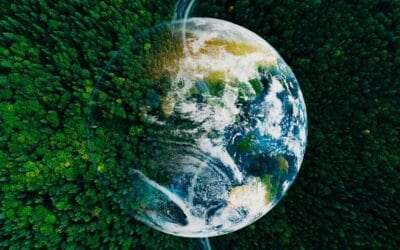
As leaders convene in Davos for the World Economic Forum, much of the discussion will focus on risk, resilience, productivity, and long-term growth. Yet the most fundamental economic question remains largely unasked: would a rational investor choose to invest in Planet Earth as it is currently managed?
Imagine, for a moment, an interplanetary investor assessing Earth not as a home, but as an asset; considering whether to allocate capital into its future. They would not be buying the planet outright, but buying into its trajectory. On today’s evidence, the investment case would be deeply troubling.
Humanity has proven to be a remarkably poor manager of its ultimate asset: a healthy, functioning biosphere. We have degraded soils, destabilised the climate, depleted ecosystems, polluted oceans, and compromised atmospheric stability; all while recording short-term economic gains and systematically excluding the damage from our accounts.
If Earth were a corporation, no competent board would accept this governance. No investor would tolerate balance sheets that recognised profits but ignored mounting liabilities. And no regulator would allow such behaviour to continue unchecked.
The failure is not capitalism. It is the rules under which capitalism has been allowed to operate.
Modern economies function without whole-Earth system accounting. We do not formally recognise the biosphere as productive capital, nor do we maintain sinking funds for its maintenance and repair. The result is a vast accumulation of unfunded environmental liabilities, quietly transferred to future generations.
Empathy Economics proposes a correction to this failure. It is a framework within which humanity, and all life on Earth, can thrive by aligning economic systems with biophysical reality.
At its core, Empathy Economics recognises a simple truth: the economy is a wholly owned subsidiary of the living Earth. Atmosphere, oceans, soils, forests, and biodiversity are not externalities; they are foundational assets. When they are degraded, productivity falls. When they are restored, productivity rises.
This is why large-scale land restoration and ocean restoration sit at the heart of the approach. Done properly, restoration is not a cost; it is one of the most powerful productivity investments available. Healthier soils increase food security. Restored ecosystems stabilise climate systems. Functioning oceans regulate weather, fisheries, and carbon cycles. The biosphere, when repaired, pays dividends.
The Biosphere Restoration Plan builds directly on this logic. Its underlying economic case is the delivery of the Sustainable Development Goals, not as aspirations, but as outcomes enabled by restored planetary systems. Today, roughly 2.8 billion people live well, while the majority struggle within degraded economic and ecological conditions. With a functioning biosphere and the right economic framework, it becomes feasible for 9 billion people to live well by 2050.
The result would be an unprecedented expansion in global productivity and, consequently, global GDP.
What is missing are the same structures we take for granted in any well-run company.
First, legal frameworks that protect core assets. Corporations are compelled to submit accounts, disclose risks, and act within defined boundaries. Earth’s life-support systems deserve no less.
Second, robust monitoring and auditing. We already possess the tools. Modern satellite systems, sensor networks, and artificial intelligence give us the capability to measure, model, and track planetary health in near real time. What is required is the will to apply them.
With these tools, humanity can build a genuine planetary dashboard; a system that allows us to see the state of the Earth clearly, manage risks intelligently, and make informed investment decisions at a global scale.
If we do this, we unlock what may be the greatest economic opportunity in human history: the recapitalisation of the living Earth.
Empathy Economics is not about sentiment. It is about competence. It is about applying the disciplines of accounting, governance, and investment to the system that underpins all economies.
For an interplanetary investor, the conclusion would be simple. With the right rules, transparency, and restoration strategy in place, Planet Earth becomes the most compelling long-term investment imaginable.
The question for Davos is whether we are finally prepared to run it that way.