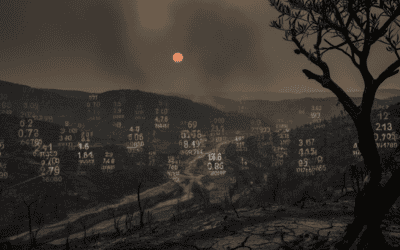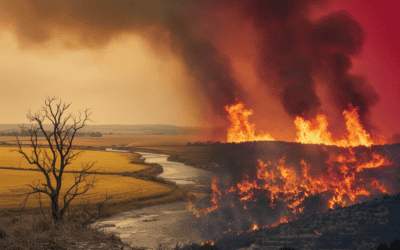

The Eastern Europe energy crisis heatwave 2026 is happening because the Danube can no longer do the two jobs Europe’s grid quietly depends on: carrying freight and carrying away heat. When river levels drop and water temperatures climb, thermal power stations lose their cooling margin, nuclear units are derated or shut down, and hydro output falls at exactly the moment air conditioning demand peaks. That is the mechanical chain. The deeper cause is a degraded landscape upstream, where drained wetlands, cleared vegetation and dried soils have weakened the small water cycle that used to recharge rivers and cool the air locally. This was foreseeable. The Danube record low water levels 2026 are the visible end of a biosphere problem that started decades ago, far from any power station.
Who This Is For: This is written for people who have to explain the Eastern Europe energy crisis to someone else by Friday. That includes analysts in green financial markets pricing utility, grid and commodity exposure across Hungary, Romania, Serbia, Bulgaria and Austria, who need a causal model rather than a weather anecdote. It includes journalists covering the energy emergency who want an explanation that goes beyond a stock photo of a cracked riverbed. And it includes climate debate participants, in policy, academia and public commentary, who keep noticing that emissions-only models underestimated how fast regional systems would break. If your job involves forecasting, reporting or arguing about this summer, you are the reader.
Why “It’s Just a Hot Summer” Stops Working This August BODY: The standard explanation has run out of road. Heat alone does not empty a river of that size, and drought alone does not explain why recovery after rainfall keeps getting weaker each cycle. Analysts tell us the same thing repeatedly: the models said tail risk, the market got base case. Journalists hit a different wall, describing an event vividly without being able to say what actually caused it. Meanwhile the public argument stays stuck on emissions targets for 2040 while a Romania energy emergency Danube scenario unfolds in real time. The uncomfortable point is that carbon accounting alone never had the resolution to see this coming.
Track how this event is developing against biosphere indicators rather than headlines on the live extreme weather dashboard at BiosphereRP.com/dashboard/extreme-weather
Reading the Eastern Europe Energy Crisis Heatwave 2026 as a Water Cycle Failure BODY: The Biosphere Restoration Project reads this event through the water cycle first, then the carbon cycle. Living landscapes move enormous volumes of water. Forests, grasslands, wetlands and healthy soils absorb rainfall, release it slowly through evapotranspiration, which is water moving from soil and plants into the air, and in doing so convert solar energy into latent heat rather than surface heat. That process cools the land, seeds inland rainfall and keeps rivers fed between storms. Strip out the biomass and drain the soils, and the same sunlight arrives as raw heat on bare, hard ground.
Across the Danube basin, that stripping has been under way for a century through drainage, channelisation, soil loss and vegetation clearance. The result is biosphere collapse water cycle behaviour: rain arrives fast, leaves fast and stops returning inland. The Eastern Europe energy crisis heatwave 2026 is what that looks like when it finally reaches the transformer. Restoration is not sentimentality here. It is thermal infrastructure.
Hungary Nuclear Shutdown Heatwave Risk and the Cooling Water Squeeze BODY: Thermal generation is the most exposed link in this chain, and it fails quietly before it fails loudly. Plants on the Danube, including Hungary’s Paks complex and Romania’s Cernavodă, draw river water for cooling and must return it within legal temperature limits. As flow falls and intake temperatures rise, operators derate first, meaning they run at reduced output, and only then consider shutdown. A Hungary nuclear shutdown heatwave scenario therefore rarely arrives as a single dramatic announcement. It arrives as a series of small capacity reductions that tighten regional day-ahead prices, pull in imports, and expose interconnector limits. Hydro at the Iron Gates falls in the same week, for the same reason. Correlated failure, not independent risk.
Step by Step: How to Assess Basin-Level Energy Risk Properly:
- Map the generation fleet by cooling dependency, not just by fuel type. Identify every unit that relies on river abstraction, and record its licence limits for discharge temperature and minimum flow.
- Pull upstream landscape data, not only meteorological data. Look at soil organic matter trends, wetland extent, forest cover change and drainage density across the contributing catchment.
- Compare this year’s recession curve with previous drought years. If the river falls faster and recovers more slowly after equivalent rainfall, you are seeing structural water cycle damage rather than a weather outlier.
- Model correlation explicitly. Assume thermal derating, hydro shortfall, freight disruption and peak cooling demand happen in the same fortnight, because physically they must.
- Stress test the interconnectors. Regional imports only help if neighbouring systems are not degraded by the same heat dome at the same time.
- Set restoration indicators as leading signals. Track catchment biomass and soil water holding capacity as forward indicators of grid reliability, using the science on the small water cycle at BiosphereRP.com/science/water-cycle.
What to Watch Out For:
- Treating each summer as an independent event. Repeated biomass destruction drought Europe cycles compound, because each dry year reduces the soil’s capacity to hold the next year’s rain.
- Assuming rainfall solves it. Heavy rain on hardened, vegetation-poor soils runs straight off and can trigger flooding without restoring river baseflow.
- Reporting the shutdown and skipping the catchment. The most newsworthy fact is usually 400 kilometres upstream of the plant.
- Pricing only carbon exposure. Utilities can be fully compliant on emissions and still structurally short of cooling water.
- Waiting for official attribution. Formal studies arrive months after the market and the grid have already moved.
Quick Checklist BULLET LIST:
- Identify the three generating assets in the basin with the tightest cooling water margin.
- Obtain the historic low-flow gauge records for your reference stations, going back at least fifty years.
- Check whether upstream wetland and floodplain extent has fallen since the last comparable drought.
- Add river temperature, not just river level, to your monitoring set.
- Ask any utility you cover what its derating threshold is, in degrees and cubic metres per second.
- Line up freight and inland shipping disruption alongside power data, as both track the same water.
- Bookmark a live biosphere indicator source you can quote under deadline.
- Frame the story as infrastructure and water, and watch how much faster non-specialist readers understand it.
FAQ: Q: Why is the Danube so low in 2026? A: The immediate driver is a prolonged heat dome combined with a rainfall deficit through spring and summer, which reduced snowmelt contribution and evaporated soil moisture early. The structural driver is a catchment that has lost much of its sponge capacity through drainage, soil degradation and vegetation loss, so it stores less water between rainfall events. Low flow now arrives sooner and lasts longer for the same weather conditions.
Q: Can a heatwave really shut down a nuclear power station? A: Yes, though usually through reduced output rather than a full stop. Reactors need cooling water within specific temperature and volume limits, and when the source river is too warm or too shallow, operators cut output to stay within their discharge licence. Several plants on the Danube and Rhône have derated for exactly this reason in previous European heatwaves.
Q: Is this an energy problem or a climate problem? A: It is a biosphere problem that presents as both. Emissions raise the baseline temperature, but the severity of regional drying is amplified by degraded land that no longer cools itself or retains water. Treating it purely as an emissions issue leads to policy that will not stabilise river flow within the timescales the grid needs.
Q: What would actually fix this? A: Rehydrating the landscape at catchment scale, through wetland restoration, soil carbon recovery, tree and hedgerow planting, and slowing water on its way downhill. These measures rebuild evapotranspiration and groundwater recharge, which support baseflow in dry months. The work is slow, cheap relative to grid reinforcement, and measurable within years rather than decades.
You now have a choice about how you frame the next twelve months of this story. You can carry on treating each drought summer as an unlucky outlier and be surprised again next August, or you can start reading river flow, soil moisture and catchment biomass as the leading indicators of European energy reliability that they demonstrably are. Analysts who make that switch will price the correlation before the market does. Journalists who make it will explain the emergency while everyone else is still describing it. The data to make the switch already exists.
See the current biosphere and extreme weather indicators for the Danube basin and beyond at the Biosphere Restoration Project extreme weather dashboard, updated as the situation develops.