
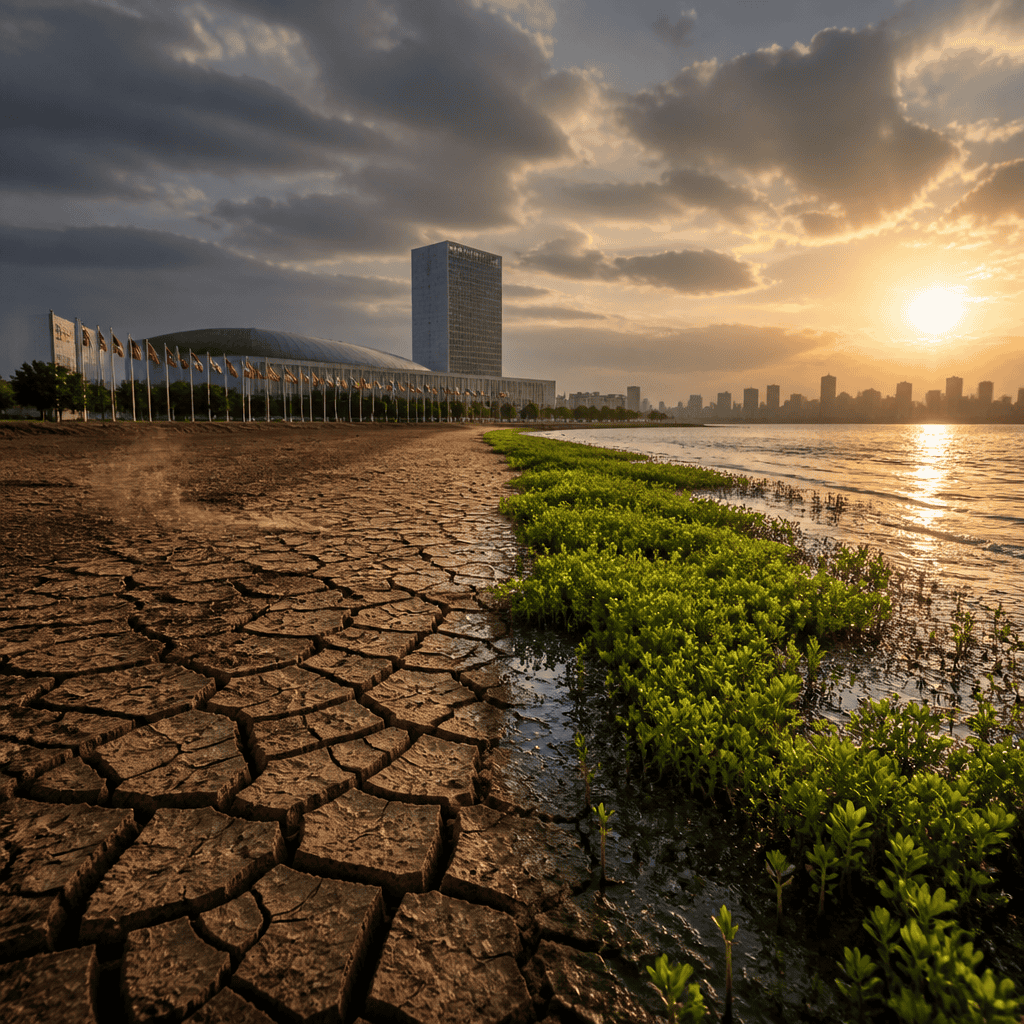
Yes, the world has already crossed 1.5°C in real time, and no, that crossing does not yet count officially, because the Paris Agreement’s temperature goal is conventionally read as a 20-year average. That single definitional choice is what currently blocks 1.5°C climate threshold legal accountability. A state can preside over a year at 1.55°C, as 2024 was, and still argue that nothing has legally happened, because the averaging window will not close until the 2030s. The physics has moved. The evidentiary standard has not. My argument in this piece is straightforward: the measurement convention was designed for scientific caution, not for legal impunity, and it is now doing the second job far better than the first.
Who This Is For
This is written for three groups who keep colliding over the same number. Journalists and editors covering climate attribution, who are told by one source that 1.5°C has been passed and by another that saying so is inaccurate. Analysts and stewardship leads in green financial markets, who price transition risk, sovereign exposure and litigation risk against a threshold that cannot formally be triggered inside a normal investment horizon. And climate debate participants, campaigners, litigators, policy advisers and researchers, who are arguing about targets while the definitional ground shifts underneath them. If you have ever had to explain why a breach is both real and not official, this is for you.
The Breach That Never Officially Happens
The complaint I hear most often is blunt: “We cannot report a breach that the science will not confirm for another decade.” Journalists get caught between a WMO headline figure and a caveat that neuters it. Investors get told that sovereign and corporate exposure to a 1.5°C overshoot is material, then discover there is no date on which overshoot is declared. Litigators face the same wall, because a duty is easiest to enforce when the breach has a timestamp. The result is a crime scene with no time of death. Everyone can see the body. Nobody is allowed to write the certificate.
This piece responds to Dr Tom Harris’s analysis in Climate Uncovered (August 2026), which sets out the legal architecture of the measurement trap in full. If you want the underlying technical argument, including the ICJ and ITLOS advisory opinions and the data behind the measurement problem, read the Climate Uncovered piece directly.
To track how biosphere conditions are evolving against these thresholds in real time, visit BiosphereRP.com
Restoring 1.5°C Climate Threshold Legal Accountability Starts With How We Measure
Accountability follows evidence, and evidence follows measurement design. At Envisionation we have argued for years that the climate conversation is distorted by lagging indicators, targets set decades out, pledges reported in aggregate, and thresholds averaged over periods longer than most political careers. Our position is that cooling is a measurable outcome, not a pledge, and the same discipline should apply to warming. If the biosphere can be monitored in near real time through satellite radiative flux, ocean heat content, sea ice extent and surface temperature reanalysis, then a rolling, published, real-time index of threshold exceedance is technically available now.
That matters legally. A 20-year average climate law standard tells a court that harm is only provable in retrospect. A real-time index tells a court that harm is occurring, measurable and attributable in the present tense. The second standard supports duty of care arguments. The first quietly supplies a defence. This is the measurement trap around 1.5°C, and it is a design choice, not a law of nature.
ICJ Climate Liability 2025 and the Evidence Gap in Court
The International Court of Justice’s July 2025 advisory opinion changed the legal weather. It confirmed that states carry obligations under climate treaties and customary international law, that 1.5°C is the operative temperature goal, and that failure to act with due diligence can constitute an internationally wrongful act with consequences including cessation and reparation. What the opinion did not do was settle the evidentiary question of when a Paris Agreement legal breach becomes demonstrable.
That gap is where the next five years of litigation will be fought. Claimants will need a defensible, public, contemporaneous measure of exceedance. Defendant states will lean on averaging conventions and uncertainty ranges. For anyone modelling sovereign risk or corporate liability, the practical question is no longer whether obligations exist. It is which measurement standard a court accepts.
Step by Step: How to Assess a 1.5°C Breach Claim Without Falling Into the Measurement Trap
- Identify which temperature series is being cited. Copernicus, NASA GISS, HadCRUT, NOAA and Berkeley Earth use different baselines and coverage. A figure without a named dataset and a named pre-industrial baseline is not yet a fact.
- Establish the averaging window explicitly. Ask whether the claim refers to a single calendar month, a calendar year, a 12-month rolling period, a 10-year mean or a 20-year mean. State it in your copy or your note. Most public confusion collapses at this step.
- Separate the physical claim from the legal claim. Real-world exceedance and treaty-defined exceedance are different assertions with different burdens of proof. Report both, and say plainly which one you are making.
- Check who benefits from the definition in use. If a government, trade body or issuer is relying on a long averaging window to defer action, that is itself a reportable fact.
- Cross-reference lagging temperature data with faster indicators. Ocean heat content, Arctic and Antarctic sea ice extent, and top-of-atmosphere energy imbalance move sooner than a 20-year mean and are publicly available.
- Record the date and version of every figure you use. Reanalysis products are revised, and litigation-grade reporting needs an audit trail.
What to Watch Out For
- Baseline switching. Comparing a 1850 to 1900 baseline figure against a 1961 to 1990 one produces a difference of several tenths of a degree and an argument that goes nowhere.
- Treating uncertainty ranges as disagreement. A stated margin of error is a feature of good science, not evidence that the finding is contested.
- Accepting “we will know in 20 years” as a neutral statement. It has a beneficiary, and it is rarely the claimant.
- Conflating exceedance with permanence. A single year above 1.5°C is not the same as a stabilised breach, and overclaiming hands critics an easy correction.
- Assuming emissions reduction alone resolves the exposure. Cutting inputs does not remove the heat already in the system.
Quick Checklist
- Name the dataset, the baseline and the averaging window in every temperature claim you publish or model.
- Keep a separate line in your risk notes for physical exceedance and treaty-defined exceedance.
- Track the ICJ advisory opinion’s uptake in domestic and regional courts through 2026 and 2027.
- Add ocean heat content and sea ice extent to your monitoring set alongside surface temperature.
- Ask issuers and sovereigns directly which threshold definition their transition plan assumes.
- Log the publication date and version number of every reanalysis figure you cite.
- Test whether your own reporting or modelling inherits an averaging assumption you have never examined.
- Look at restoration and cooling interventions as a measurable category, not only emissions reduction pledges.
FAQ:
Has the world already passed 1.5°C?
In real-world terms, yes. 2024 was the first calendar year to exceed 1.5°C above the 1850 to 1900 baseline, at roughly 1.55°C according to WMO’s consolidated assessment. Under the averaging convention normally applied to the Paris Agreement goal, that single year does not constitute a formal breach, because the goal is read as a long-term mean.
Why is the 1.5°C target measured over 20 years?
The convention comes from climate science, where multi-decadal averaging removes the noise of El Niño, volcanic eruptions and natural variability so that the underlying trend is visible. It is a sound scientific practice. The problem is that it was adopted into a legal and policy instrument without anyone deciding what it would mean for enforcement timing.
What did the ICJ say about climate liability in 2025?
The International Court of Justice’s advisory opinion of July 2025 found that states have binding obligations to prevent significant climate harm, that 1.5°C is the applicable temperature goal, and that breaching those obligations is an internationally wrongful act attracting consequences such as cessation and reparation. It is advisory rather than directly binding, but it now anchors claims in national and regional courts.
Can real-time climate data be used as legal evidence?
It can, provided it is published, versioned, methodologically transparent and produced by an independent body. Satellite radiative flux measurements, ocean heat content records and reanalysis temperature products already meet most of those conditions. The obstacle is legal convention rather than data availability.
You are going to write, model or argue about 1.5°C again within weeks. The question is whether you carry the averaging assumption forward unexamined, or whether you make the measurement standard itself part of the story. Every time a breach is described as unprovable until the 2030s, a decade of accountability quietly disappears, and the interventions that could still cool the system stay unfunded and untested. Naming the definition is not a technicality. It is the difference between a threshold that constrains behaviour and one that decorates a communiqué. Choose which you are reporting.
See real-time biosphere measurement in action — and track how current conditions compare to the 1.5°C threshold — at BiosphereRP.com