More than 900 people are confirmed dead in Nepal and thousands are still missing. Some bodies were carried 240 kilometres downstream into India. Those figures have moved every day this week and will move again before you finish reading, and each revision is a family in the Trishuli valley learning something they cannot unlearn.
Turning a disaster of this scale into an argument is a delicate thing to do, and it is only worth doing if the argument helps prevent the next one. So here is mine.
What happened above the Langtang valley on 26 August is not a distant tragedy. It is a reading from the same instrument that measures Britain’s weather. Different symptoms, one patient.
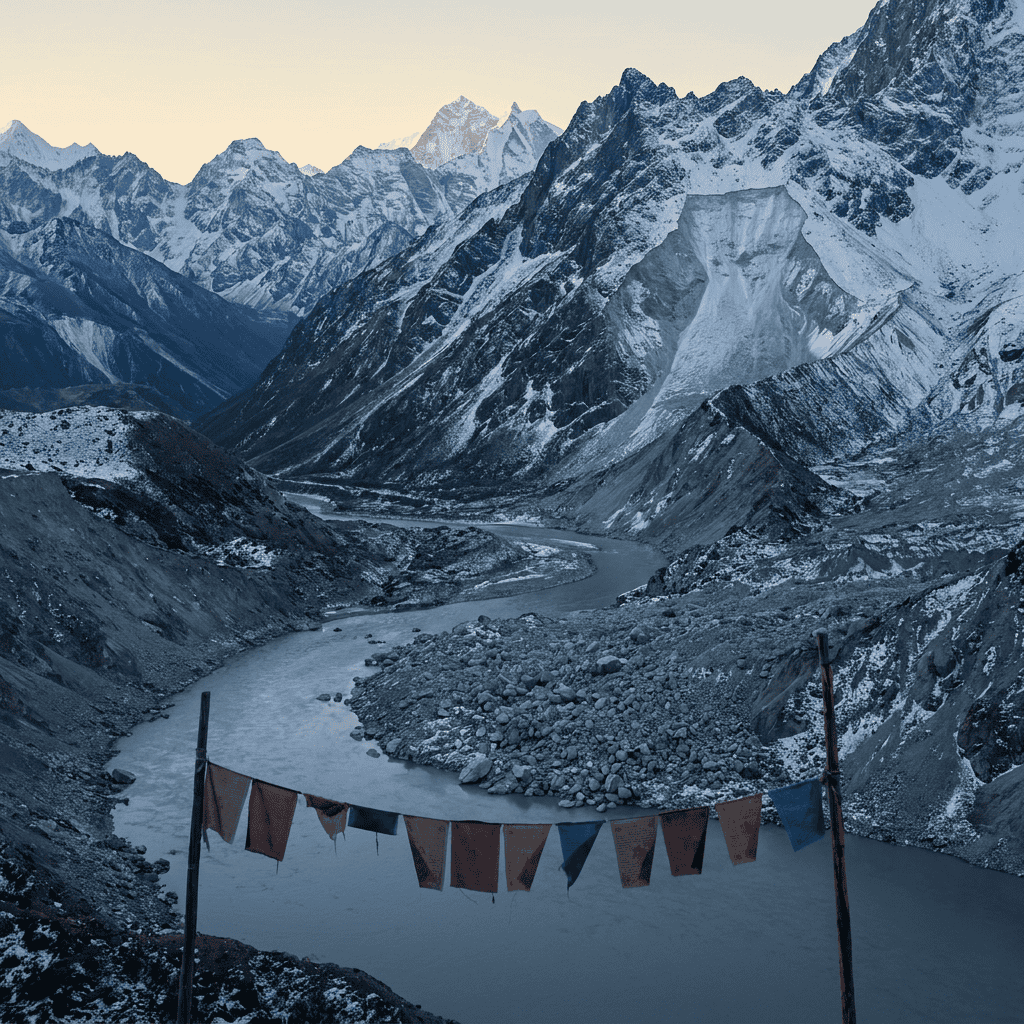
The immediate cause was local. Ice and rock sheared off a mountain flank at around 5,200 metres, sending a surge estimated at nine metres high down the valley at more than 50 kilometres per hour. The underlying cause is global. We have one atmosphere and one water cycle, and we have altered how both move heat and moisture.
Here that shows up as flash flooding in July, hosepipe bans in August, and winter storms arriving in violent sequence. And the frame most coverage will reach for, degrees of warming and dates for net zero, cannot explain what happened in Nepal. Which means it cannot tell anyone what to do next.
The Carbon Emissions-Only Frame Cannot Explain What Just Happened
The dominant explanation stops one step too early. The Himalayas are warming faster than the global average. Glaciers are retreating. This is what climate change looks like. All true, and all insufficient.
I hear the consequence of that gap from three directions. Editors tell me they are stuck choosing between a graph and a body count. Analysts tell me their physical risk screens go quiet above 2,000 metres, so Himalayan hydrology sits nowhere in their models even as it sits underneath their agricultural and utility exposure. And people sceptical of the emissions-only narrative tell me they suspect something is being left out.
They are right. The water cycle is being left out.
We describe warming in degrees, but the damage arrives as water, in the wrong place, at the wrong speed, in the wrong volume.
Reading the Nepal Glacier Collapse Climate Change Signal Correctly
Read this as a water cycle signal first and a temperature signal second.
Warmer air holds roughly seven per cent more water vapour for every degree of warming. That is thermodynamics rather than projection, and Climate Central sets out what it means for rainfall intensity (https://www.climatecentral.org/climate-matters/hurricane-season). Monsoon systems now deliver their water or snow in shorter, heavier bursts.
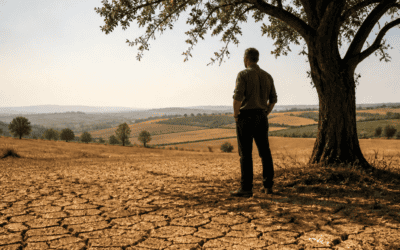
Meanwhile, land use change has stripped the vegetation and soil structure that once slowed water down, held it, and returned it to the air gradually through evapotranspiration, the process by which plants and soils move water back into the atmosphere and stabilise the climate.
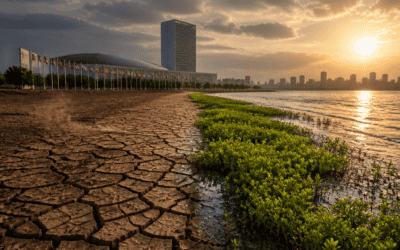
Remove that buffering and one broken cycle produces two failure modes: catastrophic surge when the water comes, and drought when it does not.
One finding from this summer deserves more attention than it received. World Weather Attribution’s assessment of the Assam floods concluded that the impacts were driven substantially by exposure and structural vulnerability, with the rainfall trend itself uncertain (https://www.worldweatherattribution.org/2026/). The scientists whose job is attributing extreme weather to warming are telling us that what the water meets when it lands matters as much as how much of it falls.
Glacial collapse is what a mismanaged water cycle looks like when it meets a mountain.
I have made this argument at Envisionation for over a decade, and for most of that time it was a minority position in rooms where emissions accounting was the only permitted subject. Cooling the Arctic, restoring the biosphere capacity to manage moisture, and repairing regional water cycles are not adjuncts to emissions reduction. They address the damage happening now, on the timescale it is happening.
Himalayan Glacier Melt and UK Impact: The Physical Chain
Himalayan glacier melt reaches Britain through the ocean and the jet stream, not through the news cycle. Let me be precise about that claim, because the readers I most want will check it, and should.
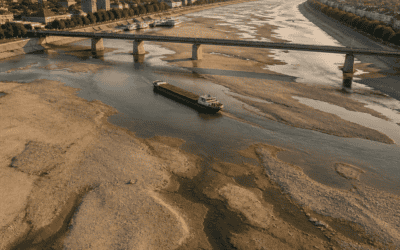
Changes in heat and moisture distribution across Asia alter regional pressure patterns, which feed into the hemispheric circulation that steers Atlantic weather towards these islands. This is one contributing mechanism among several, and the research is live rather than settled. The symptom is not in dispute: a weakened, meandering jet stream is why Britain now gets stuck, with three weeks of blocked high pressure and burnt lawns followed by a fortnight of storms queueing across the Atlantic.
There is a financial chain too. ICIMOD puts the number of people depending on Hindu Kush Himalaya river systems for water, food and energy at close to two billion, and its 2026 outlook records ice loss rates that have doubled since 2000 (https://www.icimod.org/press-releases/hindu-kush-himalaya-glaciers-losing-ice-at-double-the-rate-since-2000-new-icimod-report-confirm/). Disrupt that and you disrupt commodity prices, insurance loss ratios, sovereign credit and supply chains that British portfolios hold without ever naming the watershed involved.
The Guardian set the Nepal disaster alongside flooding in India and storm damage across the Caribbean on 31 August (https://www.theguardian.com/commentisfree/2026/aug/31/climate-crisis-nepal-floods-india-caribbean). The connective tissue between those three is not coincidence, and it is not simply temperature. It is a water cycle that has lost its regulating biomass.
Early Warning Is Not the Same as Resilience
Nepal and China have maintained a flash flood early warning system on this border for years, and it has a good record. It did not detect this.
The monitors were calibrated for monsoon and perennial flooding, not for a sudden ice and rock detachment. The upstream stations that might have registered the surge were destroyed by it before any alert could be sent. Analysts have since described the area as a monitoring blind spot.
That detail is the whole argument in miniature. We built sensors for the climate we used to have and placed them where the old climate produced its disasters. A siren without an evacuation route, maintained sensors and trained wardens is a press release.
How to Assess Glacial Hazard as a Systemic Risk
- Identify the watersheds, not the countries. Map your holdings, sources or story to specific river basins, the Trishuli, the Indus, the Brahmaputra. Hazard is hydrological.
- Ask what upstream storage exists. Glaciers and snowpack are infrastructure nobody built and nobody insures. Establish how much of a basin dry-season flow depends on ice now in retreat.
- Check the monitoring, then check what it was designed to detect. Nepal proved a funded, functioning system can still miss the event that matters.
- Trace the second-order exposure, outwards through hydropower, irrigation, water supply and transport, then to the commodities, utilities and sovereign debt sitting on top.
- Model both tails. The same broken cycle produces flood and drought. An assessment that stress-tests one of them is half an assessment.
- Price the restoration and mitigation options. Compare biosphere restoration and flood resilience in the basin against the modelled loss they avert over ten years, not thirty. Manage the drainage of glacial lakes as they develop, using satellite monitoring to detect them.
What to Watch Out For
- Treating attribution as the whole story. Establishing that warming contributed is necessary, but it tells nobody what to do on Monday.
- Confusing glacier retreat with gradual change. Ice fails abruptly, and linear projections of a non-linear process understate near-term hazard.
- Reporting the Langtang Lirung collapse as a purely local event. It is a local expression of a hemispheric circulation problem.
Accepting net zero pledges as risk mitigation. Emissions targets are necessary, but they do not stabilise a water cycle inside the next decade we need large-scale environmental restoration to achieve that: restored soils, rewilding, and the recovery of natural biomass.
FAQ:
What caused the Nepal floods in August 2026?
The immediate trigger was an ice and rock failure high in the Langtang area, releasing a surge of water and sediment into the valley below. The enabling conditions were an intensified monsoon carrying more moisture, degraded slopes with less capacity to absorb rainfall, and glacial ice destabilised by warming and tectonic uplift. Local geology set the timing. A disrupted water cycle set the scale.
Does Himalayan glacier melt affect UK weather?
Indirectly, and as one contributor among several. Changes in heat and moisture distribution across Asia influence hemispheric circulation, including the jet stream that steers Atlantic weather towards Britain. That is part of the picture behind recent blocked patterns, droughts and clustered winter storms, but not the sole cause of any single British weather event.
Can early warning systems prevent disasters like this?
They reduce loss of life when properly resourced, buying minutes to hours of evacuation time. What they cannot do is reduce the hazard, and Nepal showed a system calibrated for the wrong hazard can miss the event entirely. Prevention requires catchment scale work: restoring vegetation and soil, managing lake levels, moving infrastructure out of surge paths.
Is this just climate change, or is something else going on?
Both, and the distinction matters. Greenhouse gas accumulation drives the warming, but the damage is delivered through a water cycle that land use has separately degraded through deforestation, drainage, soil loss and urbanisation. Address only the first and you leave the delivery mechanism intact.
You have a choice about which frame you carry into your next article, investment committee paper or public argument.
You can keep describing this in degrees and deadlines, which is comfortable and changes nothing this decade. Or you can start describing it in water: where it falls, how fast, what holds it, and what happens when nothing does.
The second frame is harder to write and harder to model. It is also the only one pointing at interventions capable of working inside the timeframe these communities and these portfolios inhabit. The families still searching the Trishuli valley did not have thirty years. Neither, on the evidence, do we.
Learn more about the Biosphere Restoration Plan